Kursen omfattar cirka 130 heltidsstudietimmar varav 16 timmar obligatoriska föreläsningar/övningar, 20 timmar laboration samt 9 timmar seminarium utöver självstudier. Föreläsningarna behandlar grundläggande principer för atomkraftsmikroskopi samt en genomgång av ett antal av de viktigaste teknikerna inom AFM mätningar. I detta sammanhang behandlas också specifika instrumentella aspekter, provförberedelser, optimering av metoder och problemlösning.
FCK3114 Atomkraftsmikroskopi (AFM) av polymer- och skogsbaserade material 5,0 hp
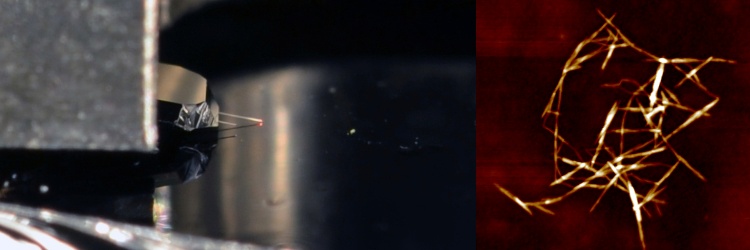
Kursen är utformad för att ge bakgrund till samt grundläggande begrepp inom och praktisk kunskap om atomkraftsmikroskopi (AFM) i dess relation till polymer- och skogsbaserade material. Doktorander som genomgår denna kurs kommer att lära sig av experter inom området, få praktisk erfarenhet av att förbereda prover, använda olika AFM-metoder och analysera AFM-data. Efter denna kurs kommer doktoranderna att ha en god förståelse för AFM och hur det kan tillämpas på deras egen forskning inom polymer- och skogsbaserade material.
Information per kursomgång
Information för VT 2026 Start 2026-03-23 programstuderande
- Studielokalisering
KTH Campus
- Varaktighet
- 2026-03-23 - 2026-05-28
- Perioder
VT 2026: P4 (5 hp)
- Studietakt
33%
- Anmälningskod
10969
- Undervisningsform
Normal Dagtid
- Undervisningsspråk
Engelska
- Kurs-PM
- Antal platser
Max: 20
- Målgrupp
- Ingen information tillagd
- Planerade schemamoduler
- [object Object]
- Schema
- Schema är inte publicerat
- Del av program
- Ingen information tillagd
Kontakt
Kursplan som PDF
Notera: all information från kursplanen visas i tillgängligt format på denna sida.
Kursplan FCK3114 (VT 2022–)Rubriker med innehåll från kursplan FCK3114 (VT 2022–) är markerade med en asterisk ( )
Innehåll och lärandemål
Kursupplägg
Kursinnehåll
Denna kurs är utformad för att ge bakgrund, grundläggande begrepp och praktisk kunskap om atomkraftsmikroskopi (AFM) i dess relation till polymer- och skogsbaserade material. Kursen innehåller:
- Arbetsprinciperna för AFM, dess huvudsakliga delar samt hur dessa samverkar
- Information som kan erhållas genom olika AFM-tekniker med relevans för polymer- och skogsbaserade material
- Hur AFM kan användas samt tillämpas inom forskning och/eller industriella miljöer
- Igenkänning av vanliga artefakter, analys av ytkraftsmätningar, tolkning av resultat med relation till ytinteraktioner
- Design av AFM-experiment med relevans för den egna forskningen
Lärandemål
Efter avslutad kurs ska doktoranden ha kunskap och förmåga att:
- Beskriva och förklara atomkraftmikroskopi (AFM)
- Förklara och skilja mellan olika AFM-tekniker
- Tolka, bearbeta och diskutera resultat erhållna med AFM.
- Kritiskt tolka AFM-data, bade egna data samt data i litteraturen med relation till polymer- och skogsbaserade material.
- Förbereda prover lämpliga för AFM-experiment
Kurslitteratur och förberedelser
Särskild behörighet
Behörig till studier på forskarnivå.
Rekommenderade förkunskaper
Behörig till studier på forskarnivå.
Kurslitteratur
Du hittar information om kurslitteratur antingen i kursomgångens kurs-PM eller i kursomgångens kursrum i Canvas.
Examination och slutförande
Betygsskala
P, F
Examination
- SEM1 - Seminarier, 2,0 hp, betygsskala: P, F
- PRO1 - Projekt, 1,0 hp, betygsskala: P, F
- LAB1 - Laborationer, 2,0 hp, betygsskala: P, F
Examinator beslutar, baserat på rekommendation från KTH:s handläggare av stöd till studenter med funktionsnedsättning, om eventuell anpassad examination för studenter med dokumenterad, varaktig funktionsnedsättning.
Examinator får medge annan examinationsform vid omexamination av enstaka studenter.
När kurs inte längre ges har student möjlighet att examineras under ytterligare två läsår.
Examinationen består av tre moment
SEM1: delta i föreläsningar och seminarier under hela kursen (minst 90% närvaro krävs på föreläsningar samt 100% närvaro på seminarium)
LAB1: deltagande i laborationer
PRO1: skriva en ”proposal”, peer review av med studenters ”proposals”, samt en kort presentation av sin egen ”proposal”.
Övriga krav för slutbetyg
Godkänt betyg på samtliga ingåendemoment krävs för slutbetyg i kursen.
Examinator
Etiskt förhållningssätt
- Vid grupparbete har alla i gruppen ansvar för gruppens arbete.
- Vid examination ska varje student ärligt redovisa hjälp som erhållits och källor som använts.
- Vid muntlig examination ska varje student kunna redogöra för hela uppgiften och hela lösningen.
Ytterligare information
Kursrum i Canvas
Registrerade studenter hittar information för genomförande av kursen i kursrummet i Canvas. En länk till kursrummet finns under fliken Studier i Personliga menyn vid kursstart.
Ges av
Utbildningsnivå
Forskarnivå
Övrig information
The course has a limited number of participants (20).
Registration to the course via electronic form:
Course fee
Free for PhD students from Department of Fibre and Polymer Technology at KTH. For others, the course fee is 5000 SEK excluding VAT.
Tentative schedule for spring 2026
Monday 23/03/2026, 8:30 – 17:00 (Lectures (all), Lab (group A & B)
Tuesday 24/03/2026, 8:15 – 17:00 (Lectures (all), Lab (group C & D)
Wednesday 25/03/2026, 8:00 – 17:00 (Lab (group C & D), Lectures (all))
Thursday 26/03/2026, 8:00 – 17:00 (Lab (group A & B), Lab (group C))
Friday 27/03/2026, 8:00 – 17:00 (Lab (group B), (Lab (group A))
Monday 30/03/2026, 8:00 – 17:00 (Lab (group D), (Lab (group all))
Tuesday 31/03/2026, 8:15 – 17:00 (Lectures (all), Lab (group D)
Wednesday 01/04/2026, 8:00 – 17:00 (Lab (group B), (Lab (group C))
Thursday 09/04/2026, 9:00 – 13:00 (Lab (group A))
Thursday 28/05/2026, 10:00 – 15:00 (Seminat (all))