KTH Logo

Sverker Sörlin Corresponding Member of The Royal Danish Academy of Sciences and Letters

The Royal Danish Academy of Sciences and Letter, founded in 1742, is a learned society composed of elected members. In March the Academy elected Sverker as corresponding member of the Humanities and Social Sciences Class.

The task of the Academy is to strengthen the position of scholarship in Denmark and further inter-disciplinary understanding. The Royal Danish Academy has about 250 national members and about 250 international members. The members are prominent scientists within both the humanities and social sciences as well as the natural sciences. Each year, a number of new members are elected, and these members will then either belong to the Class of the Humanities and Social Sciences or the Class of Natural Sciences. In even years, 9 new members of the Class of Natural Sciences are elected. In odd years, 6 new members of the Class of Humanities and Social Sciences are elected.

Sverker was elected into the Humanities and Social Sciences Class, in recognition of his academic excellence.

Links

Save the Date: The EHL becomes a KTH centre!

Join us for a joyous celebration of the Environmental Humanities Laboratory’s past decade of activities and the launch of its new start as a KTH centre. The afternoon will consist of recapping the many activities of the EHL since its start in 2011/2012 under the leadership of Director Marco Armiero (“Wasteocene“) and hosting a roundtable on the purpose, importance, and future of environmental humanities research, in Sweden, Europe, and worldwide.

If you are interested who was involved during the last decade in the EHL’s activities, check out this list.

Join us for an afternoon of reflections, sharing, and discussions, followed by a mingle. Mark your calendars!

Time & Place

Thursday 2023-01-26 15.00 – 19.00 (Stockholm time)

Division of History of Science, Technology and Environment Teknikringen 74D, plan 5
S-11428 Stockholm

Watch now! The Less Selfish Gene – Forest Altruism, Neoliberalism, and the Tree of Life

Did you miss Rob Nixon and the Archipelago Lecture on November 10th? No worries! The recording is now up and can be watched below, with or without subtitles.

Abstract

Why have millions of readers and viewers become magnetized by the hitherto arcane field of plant communication? Since the great recession of 2008, we have witnessed an upsurge in public science writing that has popularized research into forest sentience, forest suffering and the forest as collective intelligence.

This talk roots the current appeal of forest communication in a widespread discontent with neoliberalism’s antipathy to cooperative ways of being. Nixon argues that the science of forest dynamics offers a counter-narrative of flourishing, an allegory for what George Monbiot has called “private sufficiency and public wealth.

About Rob Nixon

Rob Nixon is the Barron Family Professor in Environment and Humanities at Princeton University. His books include, most recently, Slow Violence and the Environmentalism of the Poor. Nixon is currently completing a book entitled Blood at the Root. Environmental Martyrs and the Defense of Life.

Nixon writes frequently for the New York Times. His writing has also appeared in The New Yorker, Atlantic Monthly, The Guardian, The Nation, London Review of Books, The Village Voice, Aeon, Orion, Critical Inquiry and elsewhere.

Environmental justice struggles in the global South are central to Nixon’s work. He is a particularly fascinated by the animating role that artists can play in relation to social movements.

Ecopoetry for Just Futures: Transcultural Poetic Practices in the Anthropocenes

The Nordic Institute of Latin American Studies at Stockholm University and the Rizoma platform are inviting everyone to an Open Lecture. There, our division’s postdoctoral researcher Nuno Da Silva Marques, affiliated with the KTH Environmental Humanities Laboratory, is going to talk about and discuss the transcultural role of ecopoetry. Ecopoetry is a genre for peace, sustainability and ecology with deep roots in Latin American culture. Apart from Nuno, Swedish poet Jonas Gren and Argentinian poet Gisela Heffes join the debate.

The lecture takes place on 28 April 2022 from 6 to 8pm (Stockholm time). Participation is possible both on-site at the Library of the Nordic Institute of Latin American Studies at Stockholm University and online through the registration form available here.

Abstract of the event (original here)

Latin America has a robust tradition of ecopoetry featuring the work of world-renown poets as Nicanor Parra, Homero Aridjis, Esthela Calderón, among many others. Since the emergence in the 60s, this poetry has renovated the lyrical expression to mourn the vanishing of ecosystems, to propose ways to connect to the environment beyond neoliberal ideologies, and to push for environmental legislation in the region, “to fight for an e-constitution” as the ecopoem by Parra goes. Ecopoetry constitutes a kind of environmental knowledge that registers the ecological crisis contributing embodied and situated ways to relate to the planet. As a literary practice, ecopoetry revisits cultural imaginaries of nature to foster an ethics of care that traverses national and linguistic barriers. This open lecture will feature poetry readings in a transcultural and translingual perspective from Argentina-USA (Gisela Heffes), Sweden (Jonas Gren) and Portugal (Nuno Marques). The readings will be framed by discussions prompted by the moderator (Azucena Castro) to highlight ecopoetry as a kind of expression that connects environmental, cultural, biological, technological and political concerns. Attention will be paid to how ecopoetry assembles word and world, art and science, human and nonhuman to portray diverse Anthropocenes in ways attentive to situated and local experiences. At a time of accelerated species extinction, social instability and climate change, this open lecture will consider what role can (eco)poetry play as a cultural phenomenon, an epistemology and a critical practice to reweave ourselves to others and the planet.

Ten Stockholm Archipelago Lectures

The Stockholm Archipelago Lectures are part of the public activities of the KTH Environmental Humanities Laboratory and have been since 2012. It was initiated as an event that marks the presence of the EHL at the KTH Campus. This Monday we look forward to our 10th lecture by looking back in time, finishing off with the announcement of this year’s keynote speaker.

In September 2012 the historian and geographer David Lowenthal visited the Division to give a series of talks. They were entitled the Archipelago Lectures, referring in part to the Stockholm Archipelago, but also to David’s career long professional and personal interest in islands, in the Caribbean, the Mediterranean, in the Isle of Man where he had a summer house, and elsewhere. (From: Sverker Sörlin in “Defining Humanities – Division of History of Science, Technology and Environment, KTHReport 2017-2018)

The Archipelago lecture was the first major public event of the KTH Environmental Humanities Lab and has become an annual institution every fall. In the early years the lectures were held at the KTH Campus, but for the 2018 lecture with Amitav Gosh on “The Great Uprooting: Migration and Movement in the Age of Climate Change” we moved to central Stockholm and Kulturhuset Stadsteatern. The event was announced in one of Sweden’s largest morning papers, Dagens Nyheter, and attracted our biggest audience so far. A little over 100 people came to listen to Amitav Gosh.

In 2019 the Archipelago Lecture was organized in collaboration with the workers educational associations ABF and the independent opinion group Arenagruppen. “What should socialism mean in the 21st century? An ecofeminist view” with Nancy Fraiser attracted over 200 people, who came to ABF to listen. The lecture was filmed and also streamed online for the first time without us knowing that this would soon be our new normal. Former EHL researcher Roberta Biasillo writes in the Biennial report “Integrative Humanities from the years 2019 in and 2020” Nancy Fraser “engaged with the audience and with us well beyond the time of the talk – we all sat and stood together, we ate next to each other and shook our hands. One year later, on 25 November 2020, we found ourselves online and it was no coincidence that the talk was on ideas and practices of care, repair, and restitution as ways to ensure just living conditions on Earth.”

In the first year of the pandemic we went online and welcomed Achille Mbembe as our Archipelago keynote speaker. From his home in South Africa he gave the lecture “Reflections on Planetary Habitability”. This became one of the EHL’s and the Division’s most visited single events so far, with over 500 people streaming it in real time.

This year we are happy to announce Kathryn Yusoff as our keynote speaker. Kathryn is a professor of inhuman geography at Queen Mary University of London. She is the author of the acclaimed book “A billion black anthropocenes or none“. So, mark your calendars and check your connection – because on December 1 at 4.30 PM CET we are ready to go online again for the next Archipelago lecture.


Lectures from the past

September 9, 2012
“Reflections on the Environmental Humanities”
David Lowenthal, Professor Emeritus of Geography, University College London

September 11, 2013
“The Meltdown of a High Arctic Hunting Community”
Kirsten Hastrup, Professor of Anthropology, University of Copenhagen

October 9, 2014
“Environmental Racism as State-Sanctioned Violence”
Laura Pulido, Professor of American Studies and EthnicityUniversity of Southern California

November 2, 2015
“The humanities and global change research: relationships necessary, absent and possible”
Noel Castree, Professor of Geography, University of Manchester, England, and the University of Wollongong, Australia

October 27, 2016
“AlterLife in the Aftermath of Industrial Chemicals”
Michelle Murphy, Professor of History and Women and Gender Studies, University of Toronto

October 5, 2017
“Connecting Dots in Toms River and Beyond”
Dan Fagin, award-winning author, and Professor of science journalism,  New York University

September 26, 2018
“The Great Uprooting: Migration and Movement in the Age of Climate Change”
Amitav Ghosh, award-winning writer of historical fiction and non-fiction

October 7, 2019
“What should socialism mean in the 21st century? An ecofeminist view”
Nancy Fraiser, Professor, The New School for Social Research, New York

November 25, 2020
“Reflections on Planetary Habitability”
Achille Mbembe, Professor in History and Politics, University of the Witwatersrand, Johannesburg



Defence Coming up: Dirty coal – Industrial Populism as Purification in Poland’s Mining Heartland

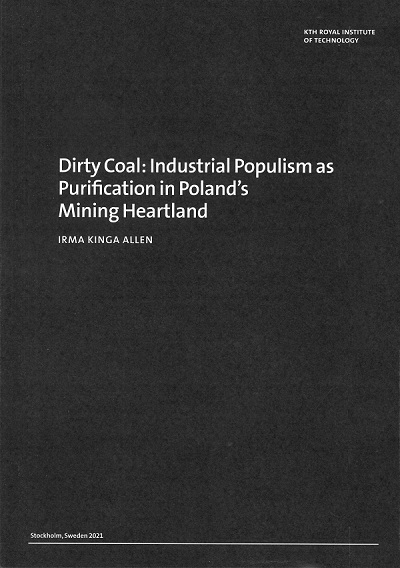
Friday October 1, it is time for Irma Allen to defend her thesis Dirty coal – Industrial populism as purification in Poland’s mining heartland. The defence is open for the public by registration, and will happen on zoom. Find link to registration below, as well as the thesis abstract!

Time: Fri 2021-10-01 16.00
Subject area: History of Science, Technology and Environment
Doctoral student: Irma Allen , Historiska studier av teknik, vetenskap och miljö
Opponent: Professor Christopher Hann, Max Planck Institute for Social Anthropology
Supervisor: Professor Sverker Sörlin, Historiska studier av teknik, vetenskap och miljö; Associate Professor Sabine Höhler, Historiska studier av teknik, vetenskap och miljö

Register for defence

Abstract

In the second half of the 2010s, far-right populist parties gained increasing power and influenceacross Europe, and around the world. Core to their ethnonationalist, anti-elite agenda, and theiremotive politics, has often been a defense of fossil fuels, threatening action to address the climatecrisis and raising the spectre of fascism. Increasingly-perceived-as-‘dirty’ coal, the raw material thatmade the industrial modern world order possible and contributed most to its mountingcontradictions, has acquired a special status in contemporary far-right ideology. What is theemotional intersection between them at a time of far-reaching economic, environmental and energyinstability and change, when coal has not only been losing its material value and its symbolic link tomodernity, but is increasingly widely deemed immoral too?

To date, studies of far-right populism have largely overlooked how energy and environmentalchange feature in their present rise. This reflects how these issues have been largely treated astechnical matters, and therefore relegated to the domain of scientific expertise, rather thanrecognized as inherently social, cultural and political concerns. Tending to adopt a macro-levelapproach, far-right studies have also not yet fully addressed the historically, geographically, andculturally-situated reasons for this success, particularly among the (white, male) industrial workingclass.From a bottom-up, ethnographic perspective, the role of intersectional (class-based,occupational, gendered, racialized regional and national) ecologically-positioned embodiedsubjectivities and identities and their emotional lived experience remains to be considered.

This PhD thesis, set within the concerns of a transdisciplinary environmental and energy humanitiesframework, addresses this lacunae in the context of Poland; the most coal-dependent country in theEuropean Union where a pro-coal platform unexpectedly helped the far-right populist party Lawand Justice (Prawo i Sprawiedliwość) into majority government in 2015. It is primarily based on ayears’ ethnographic research conducted in 2017 with both residents and particularly coal miners andtheir families in a minescape in Upper Silesia, the nation’s, and one of Europe’s, last remainingmining heartlands. Adopting a postcolonial postsocialist perspective, and drawing on rare empiricaldata from participant observation and qualitative interviews, the thesis explores the politics ofincreasingly ‘dirty’ coal expressed in localized conflicts over air pollution, domestic heating, andthe meaning of work, dignity, respectable personhood, the economy and community, setting themwithin their historical context. The rapidly shifting material and symbolic meaning of coal withinthe context of Silesia’s long-standing troubled history is particularly studied in light of Europeanintegration, a post-industrial, neoliberal, ‘green’-cosmopolitan project that links East and West in anunequal relationship. The naming of coal and its way of life as increasingly ‘dirty’ in newlystigmatizing senses from ‘outside’, is found to be experienced by the mining community as an eliteimposedprocess of ecological dispossession. This generates a toxic intersectionally-andecologically-mediated shame in the bodies of those that particularly labour intimately with itsmaterial touch; a shame that resonates with what this thesis terms industrial populist politics and itsemotive charge as a felt common sense. In the postsocialist context of the marginalization anddevaluation of industrial working-class lives, and pervasive and normalized orientalist classismexperienced as an attack on one’s ecologically-enmeshed Silesian-Polishness, the relational longingfor a sense of a purified home, that can cleanse dirt’s discomforting and shame-inducing stigmas inoverlapping economic, social, cultural and environmental terms by refusing and reversing itsdesignation, is proposed as lying at the heart of industrial populism’s visceral draw.

urn.kb.se/resolve?urn=urn:nbn:se:kth:diva-301741

STREAMS coming up this week!

This week the Environmental Humanities Laboratory at the division is hosting the long-awaited STREAMS-Conference (STREAMS-Transformative Environmental Humanities) digitally in Stockholm.


We are delighted that despite all the problems the organising committee had encountered during the Covid-19-pandemic the conference can finally take place – albeit only in a virtual format. The team has put together a very differentiated programme, encompassing a vast array of presentations, films, artwork, keynotes, roundtables and networking events. Scholars of Environmental Humanities, Energy History, Climate Change and the Anthropocene will meet artists, activists (e.g. from Extinction Rebellion Sweden) and editors on the new Streams EventsAIR Virtual Platform to facilitate a great networking experience despite the challenges of the new home-office-normality. The keynote-speakers are among others: Jürgen Renn, Adeline Johns-Putra, Michelle Bastian, Julie Sze, James Ogude and Dipesh Chakrabarty.